Data Driven Methods in Fluid Mechanics Workshop
Mar 30, 2023· ·
0 min read
·
0 min read
Omid Bidar
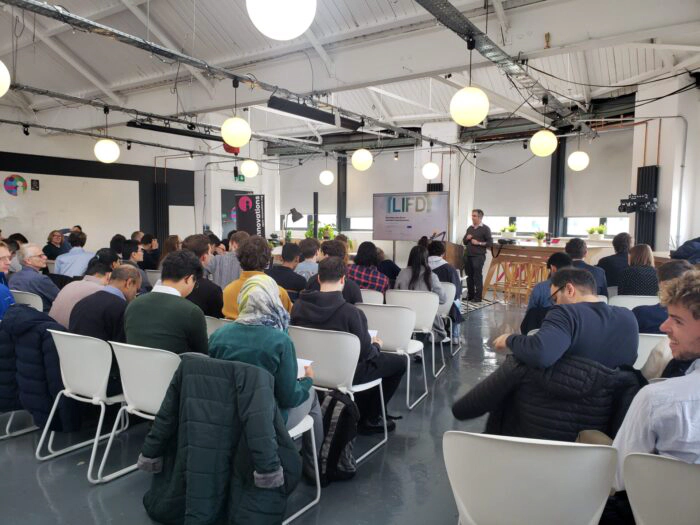 Image credit: LIFD
Abstract
In recent years a plethora of data assimilation techniques have been introduced for improved Reynolds-averaged Navier-Stokes (RANS) turbulence modelling. A number of frameworks have been shown to achieve considerable improvements using limited, experimentally measurable, data. However, most applications thus far have been primarily dictated by the availability of existing data, usually generated for benchmarking and validation. In the present study, we introduce a strategy that addresses the important task of sensor placement for generating the experimental data in the first place, specifically tailored for RANS-based data assimilation. We employ the eigenspace perturbation approach which involves systematically perturbing the eigenvalues and eigenvectors predicted by a given RANS turbulence model (e.g. k-omega SST). Specifically, six CFD simulations are run in total: one simulation with the baseline model, two simulations perturbing the eigenvectors, and three simulations perturbing the eigenvalues. All six simulations result in as many flow predictions, allowing us to generate sensitivity maps–based on the variances–for various quantities of interest (QoI). Then, for a prescribed number of sensors and for a given QoI, a gradient-free optimisation problem is solved where the sum of variance over all possible sensor locations is maximised to ensure sensors are placed in regions of flow field with highest uncertainty. A regularisation term, based on maximising the distance between the sensors, is introduced to avoid excessive clustering of sensors. Potential advantages of the approach include: not requiring experimental data; in principle, informing experiment design by directly accounting for structural errors in RANS modelling which is the basis for the eigenspace perturbation method; and relatively low computational costs compared to the methods based on deep neural networks, or other variational approaches. To investigate the effectiveness of the method, we perform data assimilation using the adjoint-based field inversion approach, with the separated flow over the 2D NASA hump as a test case. Once, the data for a given QoI has been prepared (presently using an LES dataset to emulate experimental scenarios), the field inversion process involves perturbation of the transport equation(s) for the RANS model, k-omega SST in the current study, and an optimisation solution where the goal is to minimise the error between the RANS output and the higher-fidelity data. Early results based on the current method, compared to uniform and random sensor placement strategies, demonstrate significant improvements in flow reconstruction.
Event
Location
Leeds Institute for Fluids Mechanics, University of Leeds