Research
Last updated: 17 July 2026
My research focuses on computational modelling for complex fluid flows, especially where standard engineering models are useful but not fully reliable outside the conditions in which they were developed. A recurring theme is to use data carefully: not to replace physical models wholesale, but to understand where they fail, how uncertainty enters the calculation, and how data-driven methods can improve their practical use.
The three themes below summarise current and recent work. Click a theme to expand the details, figures, representative results, and related publications.
 Research theme
Boiling heat transfer modelling
Mixture of Engineering Models, XBOIL, and data-assisted selection of boiling closures.
Explore
Collapse
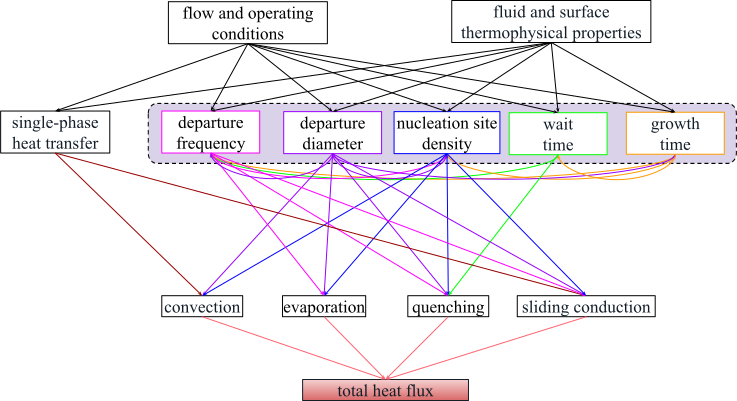
Nucleate boiling is central to nuclear thermal hydraulics and other high-heat-flux systems, but practical CFD models still depend on many empirical, semi-empirical, and mechanistic closure relations. In a heat-flux-partitioning model, the wall heat flux is decomposed into contributions such as single-phase convection, evaporation, and quenching. Each of those terms depends on further closures for bubble departure diameter, departure frequency, nucleation site density, growth time, wait time, and related quantities. The difficulty is not only that each closure is uncertain; it is that the closures interact.
1. Motivation Why boiling-model selection is difficult
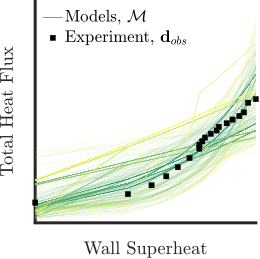
This motivates a cautious view of boiling-model prediction. A model configuration that gives a good boiling curve may do so because several sub-model errors compensate for one another. Conversely, a closure that works well in one regime can become unreliable when pressure, subcooling, mass flux, surface condition, or geometry change. The central question is therefore not simply “which correlation is best?”, but how to use a large set of plausible engineering models without pretending that any one of them is universally correct.
2. Assessment Systematic assessment with XBOIL
A first step was to separate the behaviour of boiling closures from the many additional uncertainties present in full CFD calculations. XBOIL provides a zero-dimensional, point-averaged framework for assembling heat-flux-partitioning models from different closure choices and testing those combinations against experimental data. This makes it possible to ask controlled questions about model selection, compensating errors, and the sensitivity of predicted heat flux and bubble parameters to closure choices.
The main outcome was not a new universal closure. Rather, the assessment showed that many combinations can reproduce parts of the available data, while no single fixed model configuration remains consistently reliable across the broader range of flow and pool boiling cases. It also showed that apparently reasonable wall heat-flux predictions can hide large differences in the underlying bubble-dynamics quantities. That is important for CFD, where those local quantities influence interfacial exchange and regime-dependent behaviour.
Relevant publication:
- Evaluations of boiling heat flux partitioning and bubble parameter models using a 0-D framework — International Journal of Heat and Mass Transfer, 2026.
3. Adaptive modelling Mixture of Engineering Models for boiling heat flux
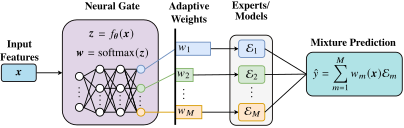
The next step is the Mixture of Engineering Models (MoEM) approach. The idea is deliberately conservative: rather than replacing decades of empirical and mechanistic boiling models with a purely black-box predictor, MoEM learns how to combine existing engineering models. A neural gate takes local operating features as input and assigns adaptive weights to a library of candidate models. The final prediction is a weighted mixture of those model outputs.
This framing is important. The machine-learning component does not replace the engineering models; it learns when different models should be trusted more or less. That makes the approach attractive for boiling, where the literature already contains many physically motivated correlations, but their ranges of validity and interactions are difficult to manage manually.
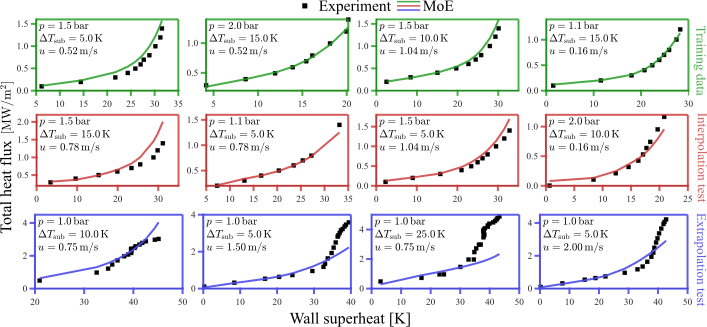
In the work presented at the 18th International Heat Transfer Conference, representative heat-flux-partitioning model configurations were treated as engineering-model experts and blended through a learned gate. The results show the intended behaviour of the method: the mixture can follow experimental boiling curves while adapting across training, interpolation, and extrapolation cases. The extrapolation cases are stated carefully because they remain the hardest test; the result is encouraging, but not a claim that the method has solved out-of-distribution boiling prediction.
Relevant publication:
- Towards data-driven boiling models using a mixture-of-experts approach — 18th International Heat Transfer Conference, 2026.
4. Closure-level test Bubble departure diameter
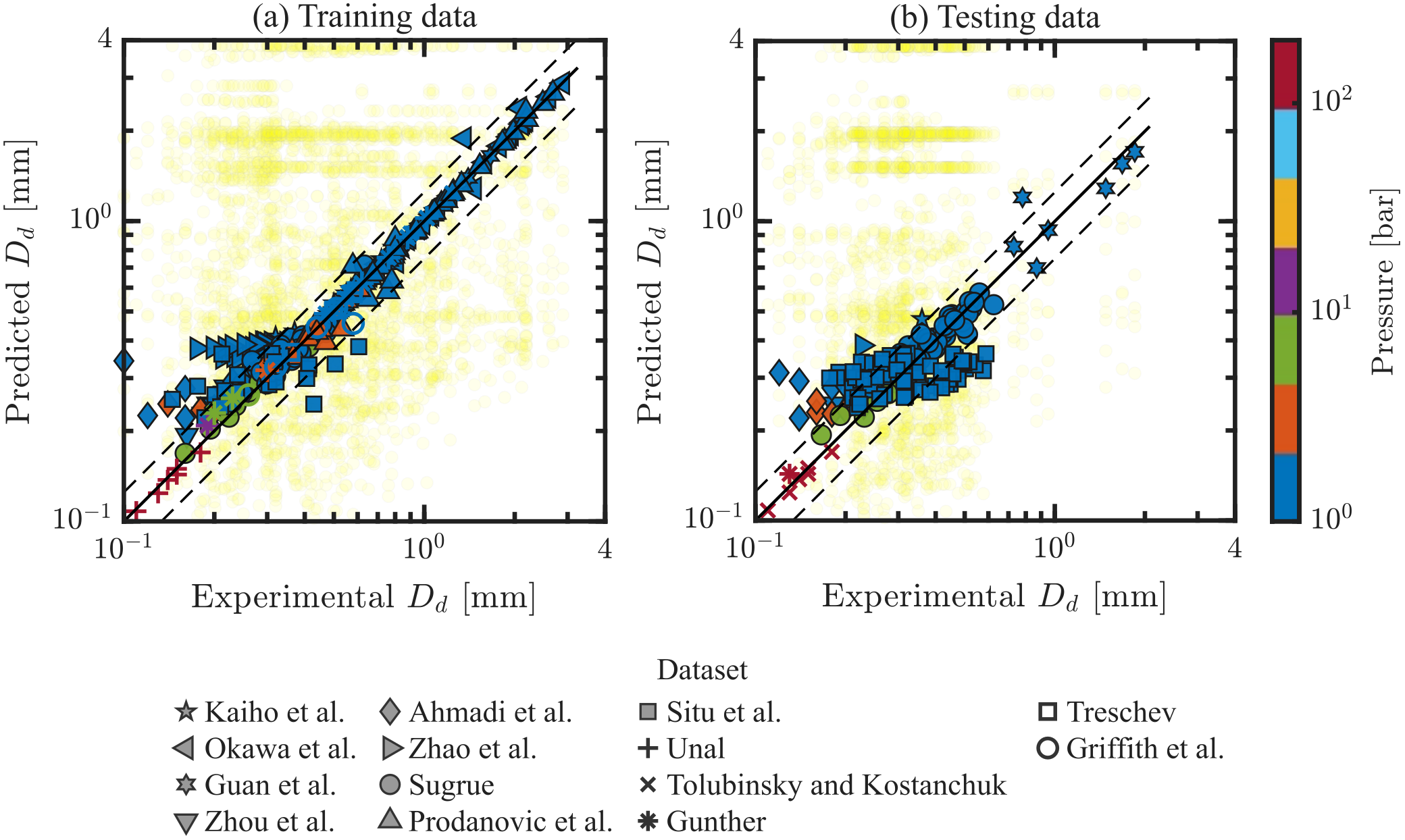
The same idea can be applied below the heat-flux level, to individual bubble-dynamics closures. Bubble departure diameter is a useful test case because it is a physically meaningful quantity, it appears in many heat-flux-partitioning formulations, and the literature contains many competing correlations with different assumptions and ranges of applicability.
In this extension, existing bubble-departure models are treated as the expert library. The neural gate learns how to blend their predictions as operating conditions change. The scatter plots show the key behaviour: the mixture tracks the experimental departure diameter over a broad set of datasets while retaining the underlying engineering models as explicit ingredients. This is presented as a closure-modelling study rather than as a final boiling CFD validation.
Relevant material:
- Neural-gated mixture of engineering models for bubble departure diameter prediction — manuscript in preparation.
- Data-driven boiling predictions: introducing the neural-gated mixture of engineering models approach — CCP/SIG Nuclear Thermal Hydraulics Annual Technical Meeting, 2026.
5. Ongoing extension Critical heat flux
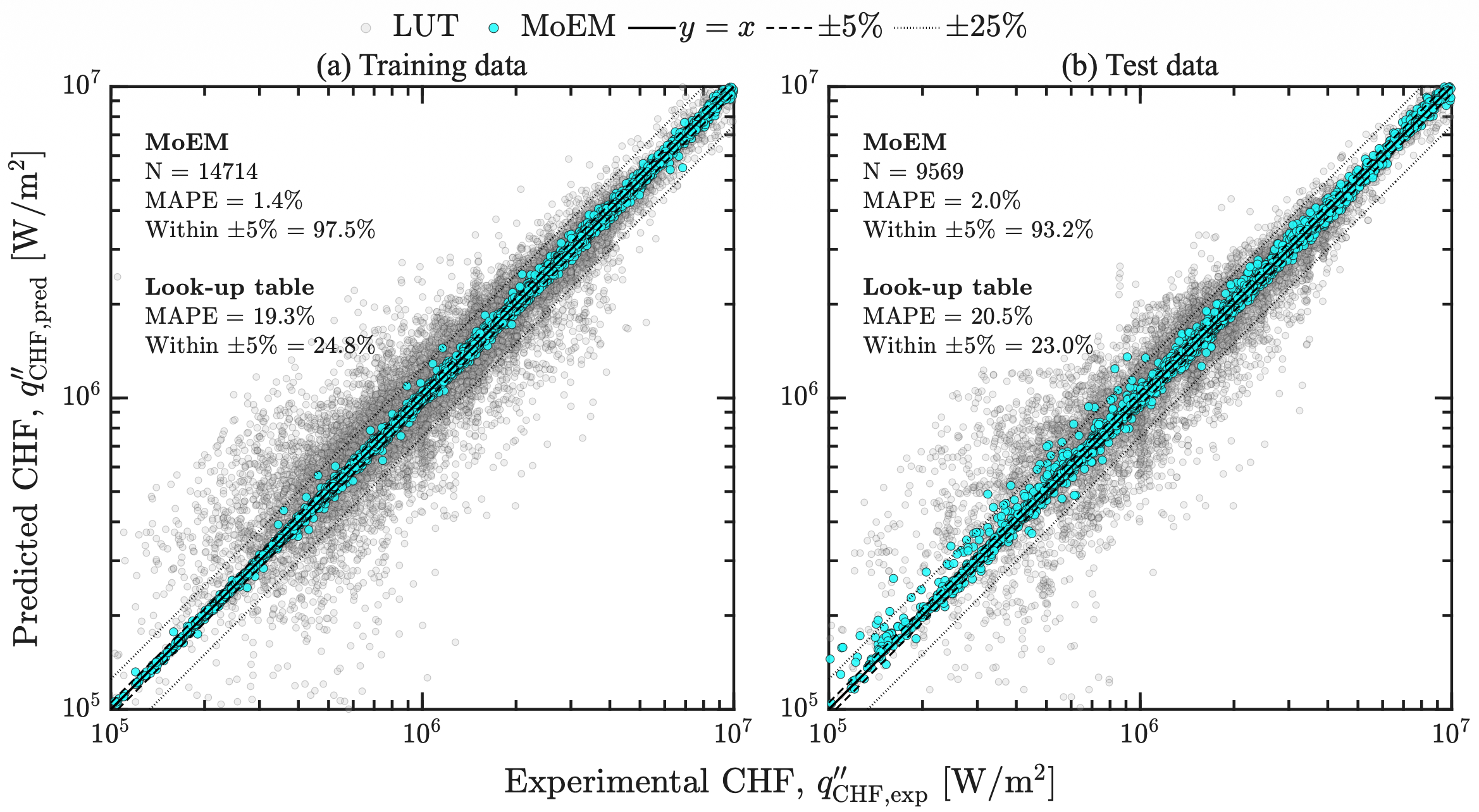
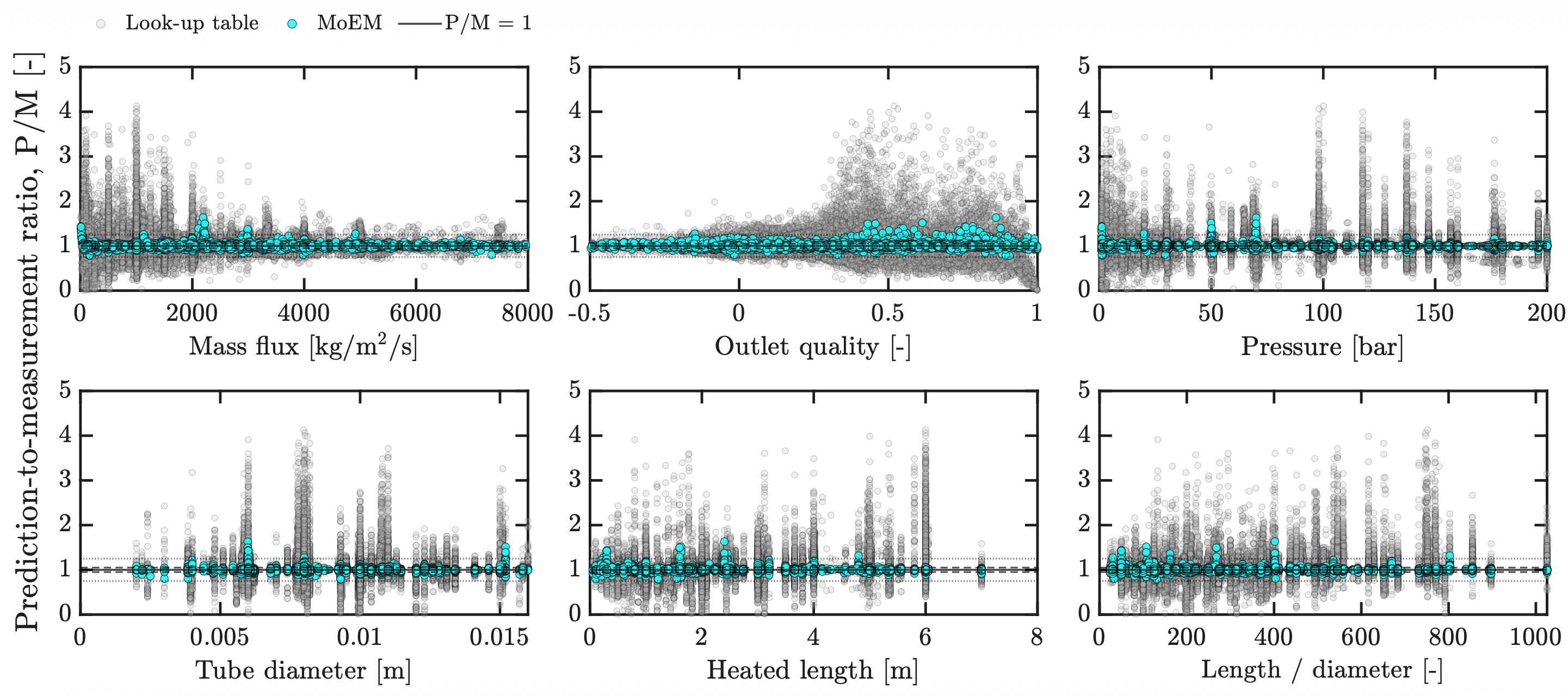
Critical heat flux is a more severe and safety-relevant prediction problem. Here the aim is to investigate whether the mixture-of-engineering-models idea can be extended from nucleate-boiling heat flux and bubble closures to CHF correlations. The current work uses a library of existing CHF models and compares the learned mixture against a large experimental database and a standard look-up-table reference.
These results are deliberately presented as interim. They suggest that an adaptive mixture can reduce some of the systematic scatter seen in fixed correlations, but the work is still ongoing and the final level of credibility will depend on further testing, careful dataset treatment, and checks against extrapolative conditions.
Relevant material:
- Mixture-of-engineering-models approach for critical heat flux prediction — ongoing work; interim results.
- Data-driven boiling predictions: introducing the neural-gated mixture of engineering models approach — CCP/SIG Nuclear Thermal Hydraulics Annual Technical Meeting, 2026.
The broader aim is to make boiling model prediction more adaptive without discarding the engineering knowledge already embedded in the literature. In the longer term, this points toward credibility-aware mixtures: models that account not only for past predictive accuracy, but also for whether each underlying engineering model is being used within a physically meaningful range of applicability.
 Research theme
Data assimilation for turbulent flows
Sensor placement, multi-sensor data assimilation, and field-inversion-based reconstruction of separated turbulent flows.
Explore
Collapse
Reynolds-averaged Navier-Stokes (RANS) models remain attractive because they are inexpensive enough for engineering design and analysis. Their limitation is that the turbulence closure can introduce structural error, especially for separated flows. Field inversion and machine learning (FIML) provides one route for using high-fidelity or experimental data to correct those models, but it raises a practical question that is easy to overlook: if the available data are sparse, what should be measured, where should it be measured, and how should different measurements be combined?
1. Motivation From field inversion to the measurement problem
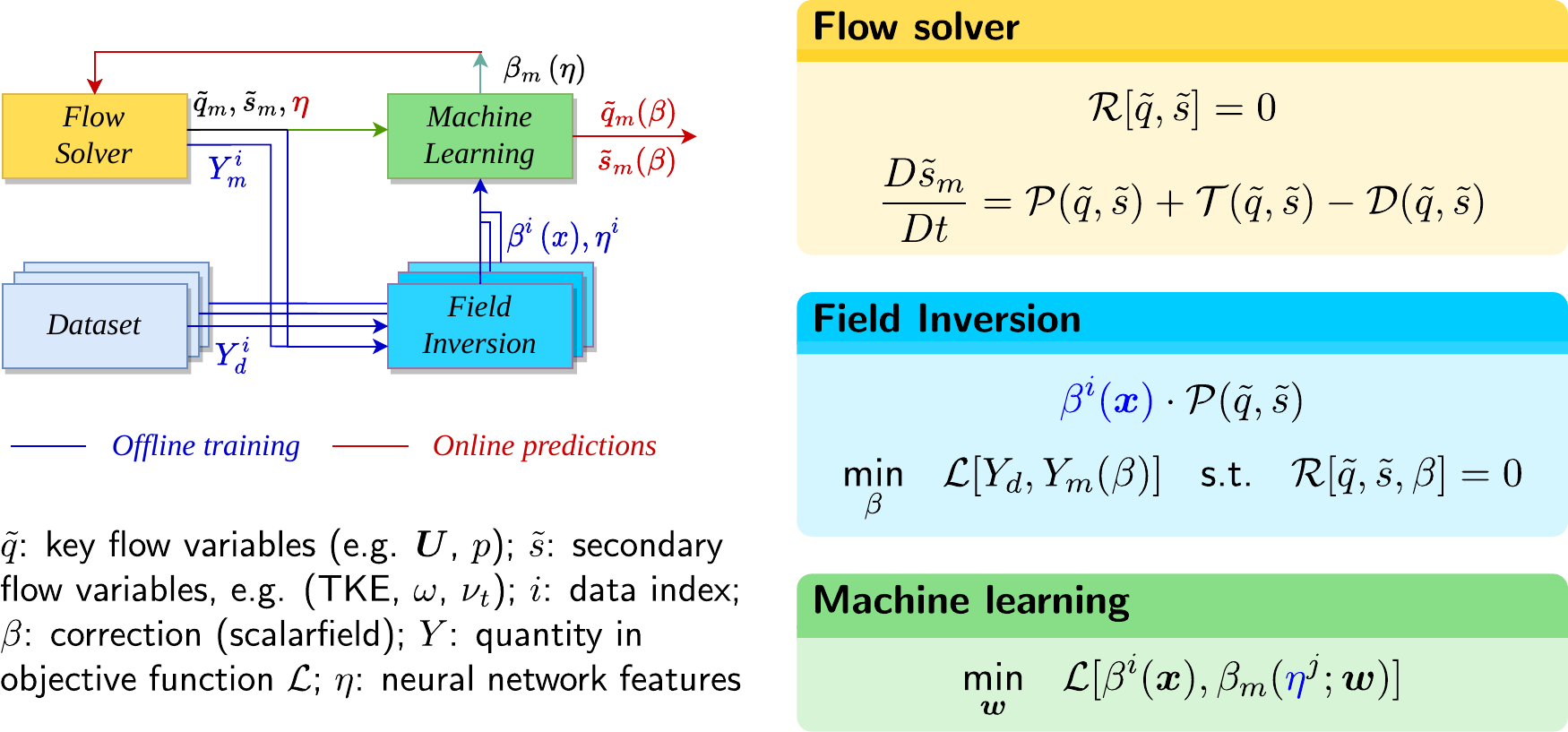
Field inversion introduces a spatial correction field into a turbulence-model transport equation and optimises that field so that the RANS prediction better matches available data. This can reconstruct separated turbulent mean flows using much less data than a full-field training dataset. The success of the reconstruction, however, depends strongly on the data supplied to the inverse problem. The work in this theme therefore concentrates on the experimental-design side of data-driven turbulence modelling: sparse sensor placement, data-type selection, and multi-sensor data assimilation.
2. Sensor placement Where should sparse measurements be placed?
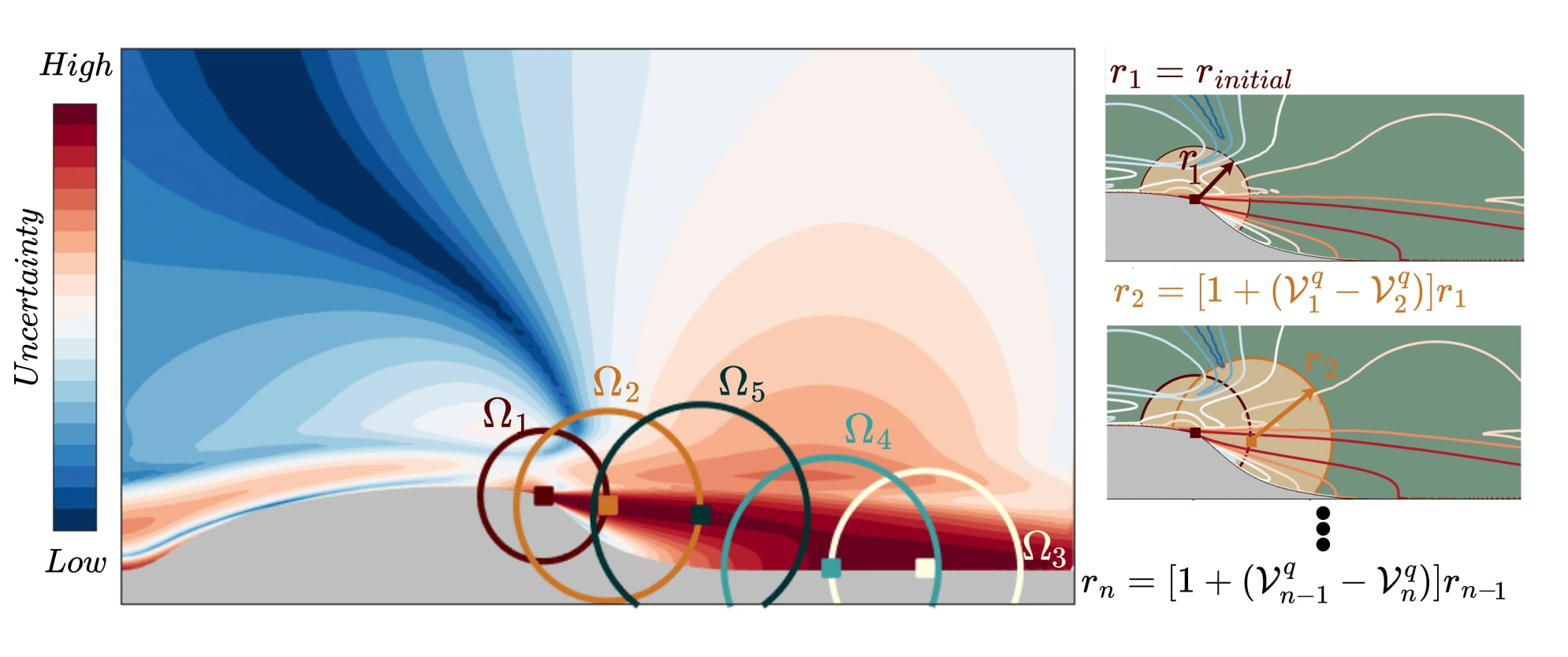
Many data-assimilation studies use whatever measurements are already available, or place sensors uniformly. That is not always a good use of limited experimental effort. A central contribution of this work is an a priori sensor-placement strategy that uses turbulence-model uncertainty itself to guide where measurements should be collected.
The method uses eigenspace perturbations of the Reynolds-stress tensor to generate spatial uncertainty maps from a baseline RANS model. A greedy placement algorithm then selects sensor locations in regions of high model-form uncertainty while avoiding excessive clustering. The aim is not to claim a universally optimal sensor set, but to provide a practical, physics-informed way to concentrate measurements where they are likely to be useful for reconstruction.
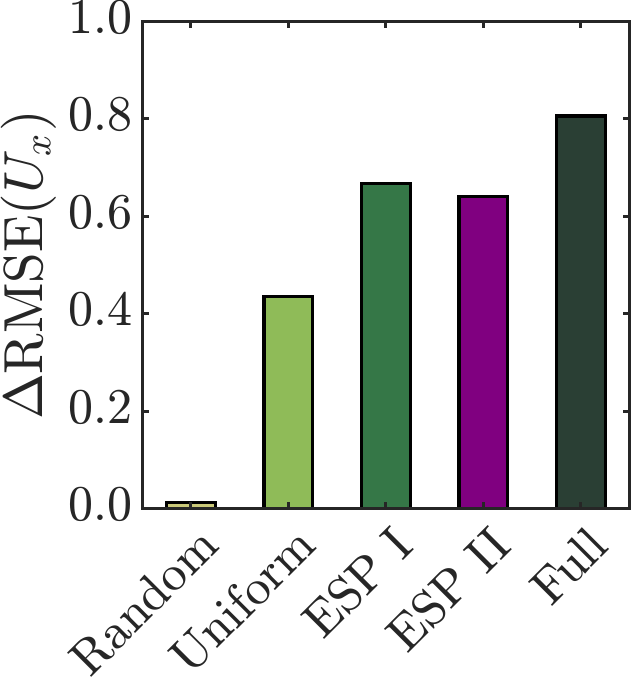
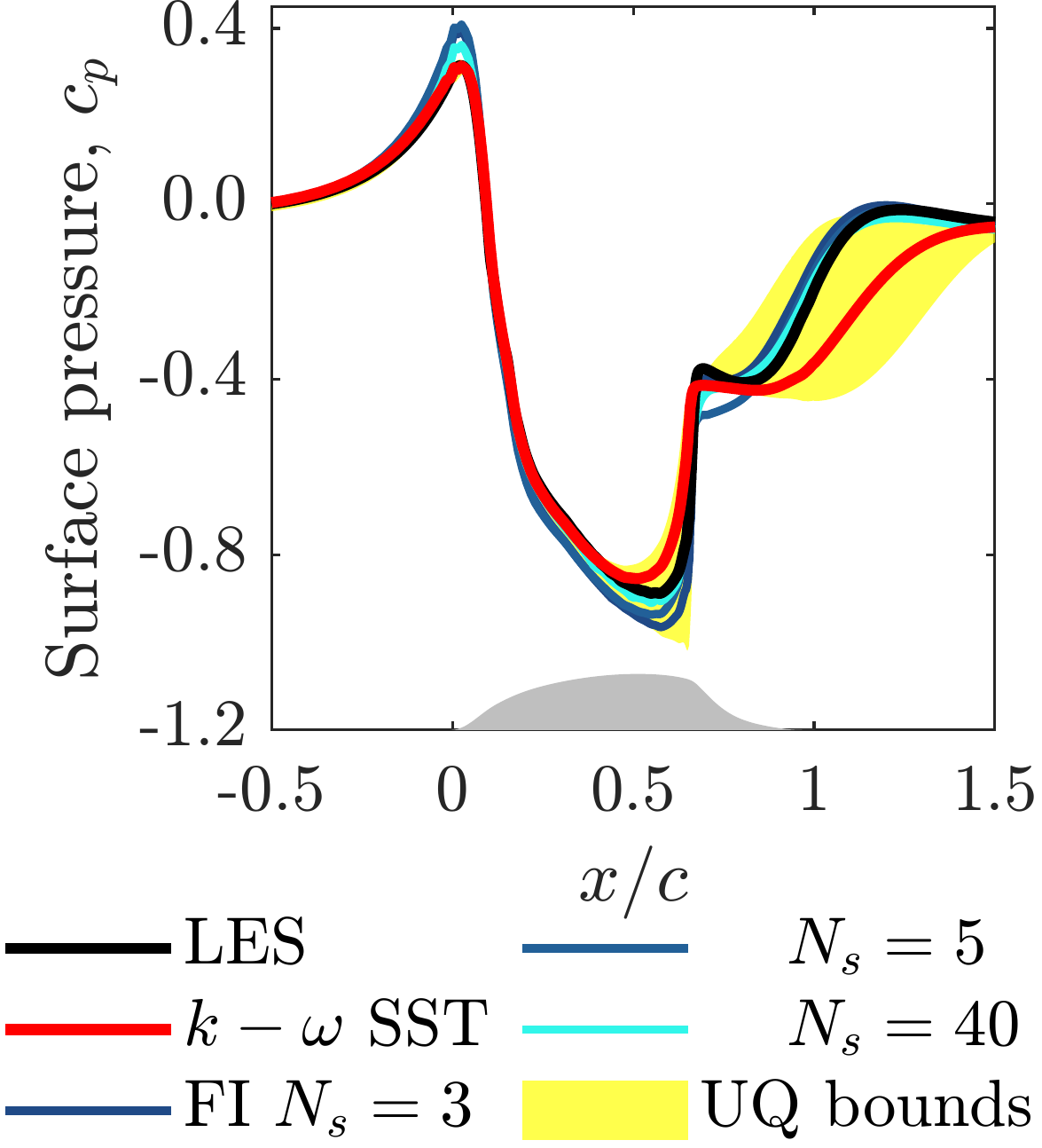
For the NASA wall-mounted hump case, the most striking result is that three sensors selected from the eigenspace-perturbation uncertainty map still produced a large reduction in the velocity error. In the paper, this three-sensor case reduced the average velocity error by about 61%, which was better than using 33 uniformly placed sensors and close to the result obtained with many more ESP-informed sensors. This is the key point: the placement strategy is not just making a sparse measurement set possible; it is making those sparse measurements more informative.

Relevant publications:
- Sensor placement for data assimilation of turbulence models using eigenspace perturbations — Physics of Fluids, 2024.
- A Priori Sensor Placement Strategy for Turbulent Mean Flow Reconstruction Using Parametric Model Perturbations — AIAA SciTech Forum, 2024.
3. Measurement choice What data should be used for reconstruction?
Sensor location is only part of the problem. Different experimentally measurable quantities constrain the reconstructed flow in different ways. Velocity profiles, surface pressure, skin friction, and integral quantities do not all contain the same information about a separated turbulent flow, and improving one quantity does not automatically mean that every other prediction improves by the same amount.
This part of the work investigates how the choice of physical quantity affects field-inversion-based reconstruction. The point is practical: when experimental data are expensive, the useful question is not simply whether data assimilation works, but which data are most informative for the flow quantities of interest. The thesis results show that the answer can depend on the flow and on the measured quantity, so the choice of data should be treated as part of the modelling problem rather than as an afterthought.
Relevant material:
- Relative Importance of Physical Quantities for Data-driven RANS-based Turbulence Modelling — UK Fluids Conference, 2022.
- Data-driven Augmentation of Turbulence Models for Complex Fluid Flows — PhD thesis, University of Sheffield, 2024.
4. Multi-sensor data How should different measurements be combined?
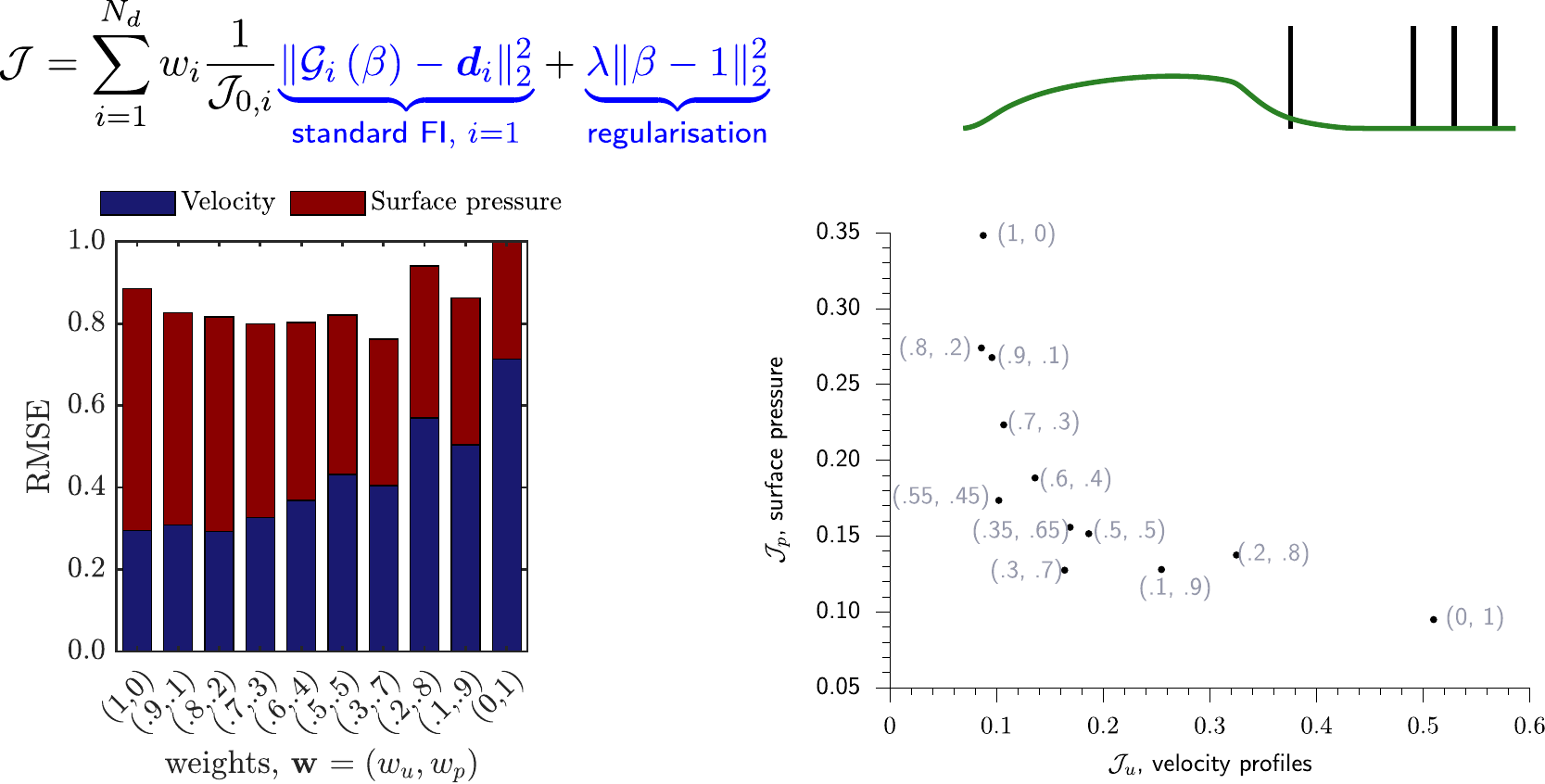
Real experiments often produce multiple kinds of data. A model calibrated to match only one quantity can still perform poorly for another, so combining data sources is a natural next step. This work extended adjoint-based field inversion to use multiple sensor/data types through a weighted multi-objective formulation.
The resulting optimisation balances the reconstruction of different measured quantities, making the trade-off explicit rather than hidden. The demonstrations on separated flows showed that multi-sensor data can improve the reconstructed mean flow, but also that the relative weighting and the chosen quantities matter. This is useful because it connects the inverse-modelling problem directly to experimental measurement planning.
Relevant publication:
- Turbulent Mean Flow Reconstruction Based on Sparse Multi-sensor Data and Adjoint-based Field Inversion — AIAA Aviation Forum, 2022.
5. Demonstration and implementation Separated-flow test cases and open-source implementation
The methods were tested on separated turbulent flows where baseline RANS predictions are known to struggle, including the NASA wall-mounted hump, a converging-diverging channel, periodic hills, and aerofoil-type cases. These cases are useful because they expose different aspects of the reconstruction problem: separated shear layers, delayed reattachment, sensitivity to turbulence-model structure, and the effect of different data sources.
The open-source implementation is important, but it is best viewed as the enabling final step. Adjoint-based field inversion is intrusive: it requires the CFD solver, adjoint solver, and optimiser to work together. This work integrated OpenFOAM, DAFoam, and pyOptSparse to make the field-inversion workflow available for further research, including the sensor-placement and multi-sensor studies described above.
Relevant publications:
- A Hybrid RANS-LES Dataset for Data-Driven Turbulent Mean Flow Reconstruction — CUFS, 2024.
- An open-source adjoint-based field inversion tool for data-driven RANS modelling — AIAA Aviation Forum, 2022.
 Research theme
Data-driven aerodynamic shape optimisation
Field inversion, learned turbulence-model corrections, and shape optimisation for separated aerodynamic flows.
Explore
Collapse
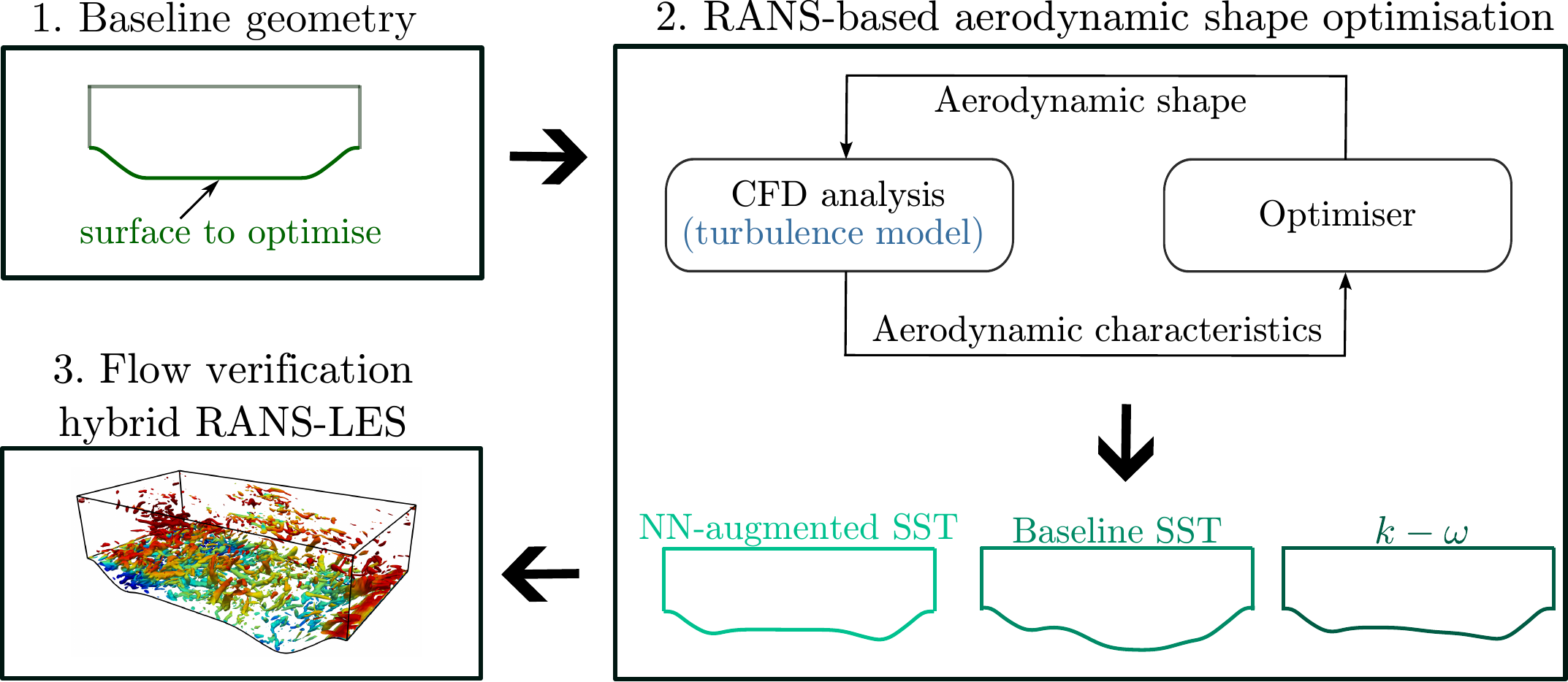
The third theme connects data-driven turbulence modelling to aerodynamic design optimisation. The central issue is that an optimiser will exploit whatever flow model it is given. If the baseline RANS turbulence model is inaccurate for separated flows, the resulting “optimal” design can reflect model bias rather than a physically meaningful improvement. Higher-fidelity methods such as IDDES can give more reliable flow predictions, but using them directly inside gradient-based optimisation is expensive and raises substantial adjoint-implementation challenges.
1. Motivation Why not optimise directly with IDDES?
The aim is not to replace high-fidelity simulation altogether. Instead, the idea is to use high-fidelity data to improve a RANS model before optimisation, so that the optimiser still runs at RANS cost while using a model that is less biased for separated flows. This matters because aerodynamic shape optimisation requires many flow and adjoint evaluations. Performing that loop with IDDES or similar scale-resolving methods would be much more expensive, and deriving robust adjoints for such simulations is far more involved than for steady RANS.
2. Learned RANS correction Embedding high-fidelity information into a RANS model
In this work, field inversion is used to infer spatial correction fields from high-fidelity data, and machine learning is then used to generalise those corrections for use in new simulations. The augmented model is still a RANS model, so it remains compatible with an efficient steady optimisation workflow. The difference is that the turbulence closure has been modified using information from higher-fidelity data over a representative set of separated periodic-hill flows.
This is deliberately a proof of concept. The training data, geometry family, and model form matter. The useful contribution is the workflow: infer corrections from high-fidelity data, embed the learned correction in the CFD solver, optimise with the augmented RANS model, and then verify the optimised result with a higher-fidelity calculation.
3. Optimisation result IDDES-like accuracy at RANS optimisation cost
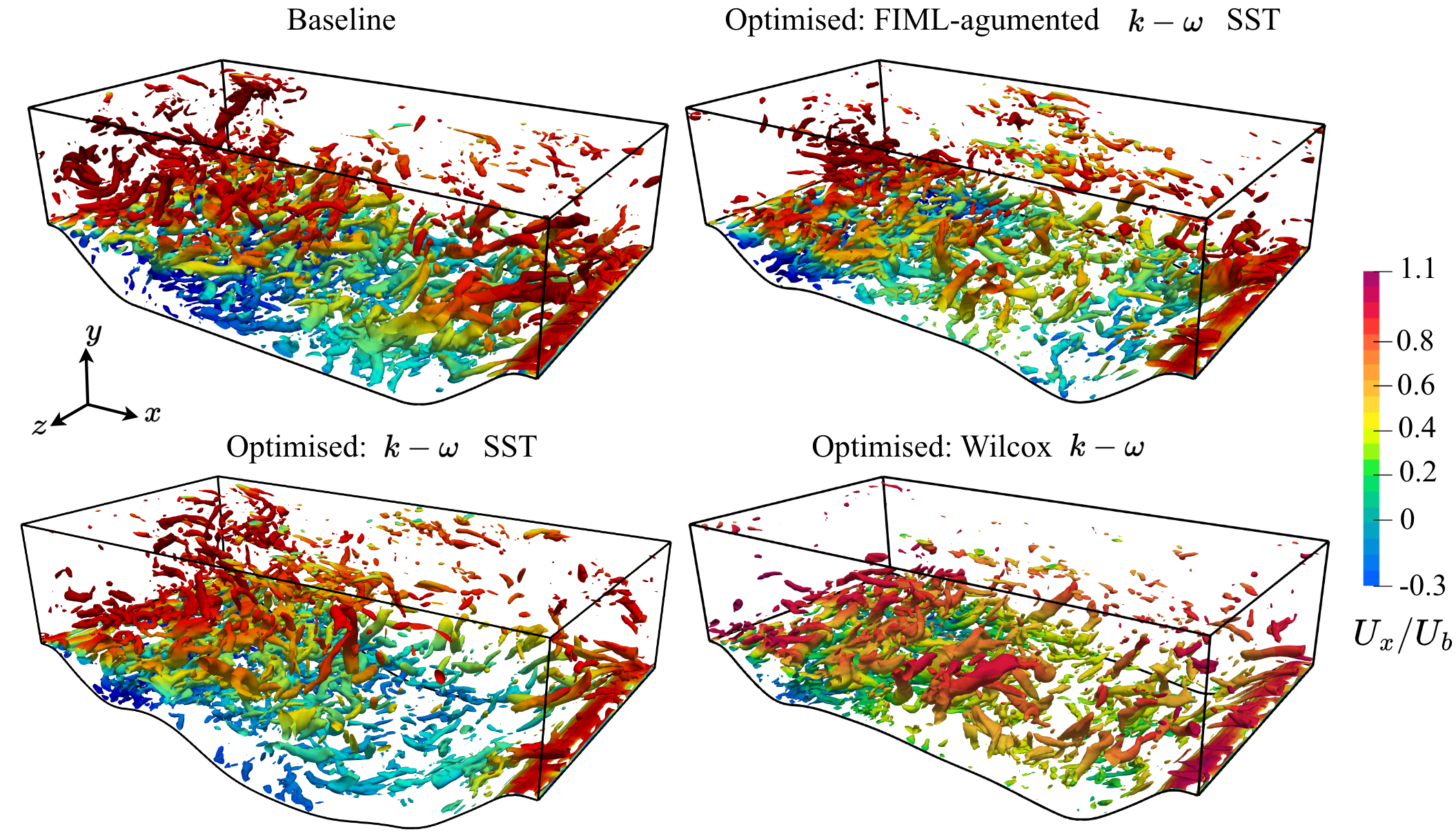
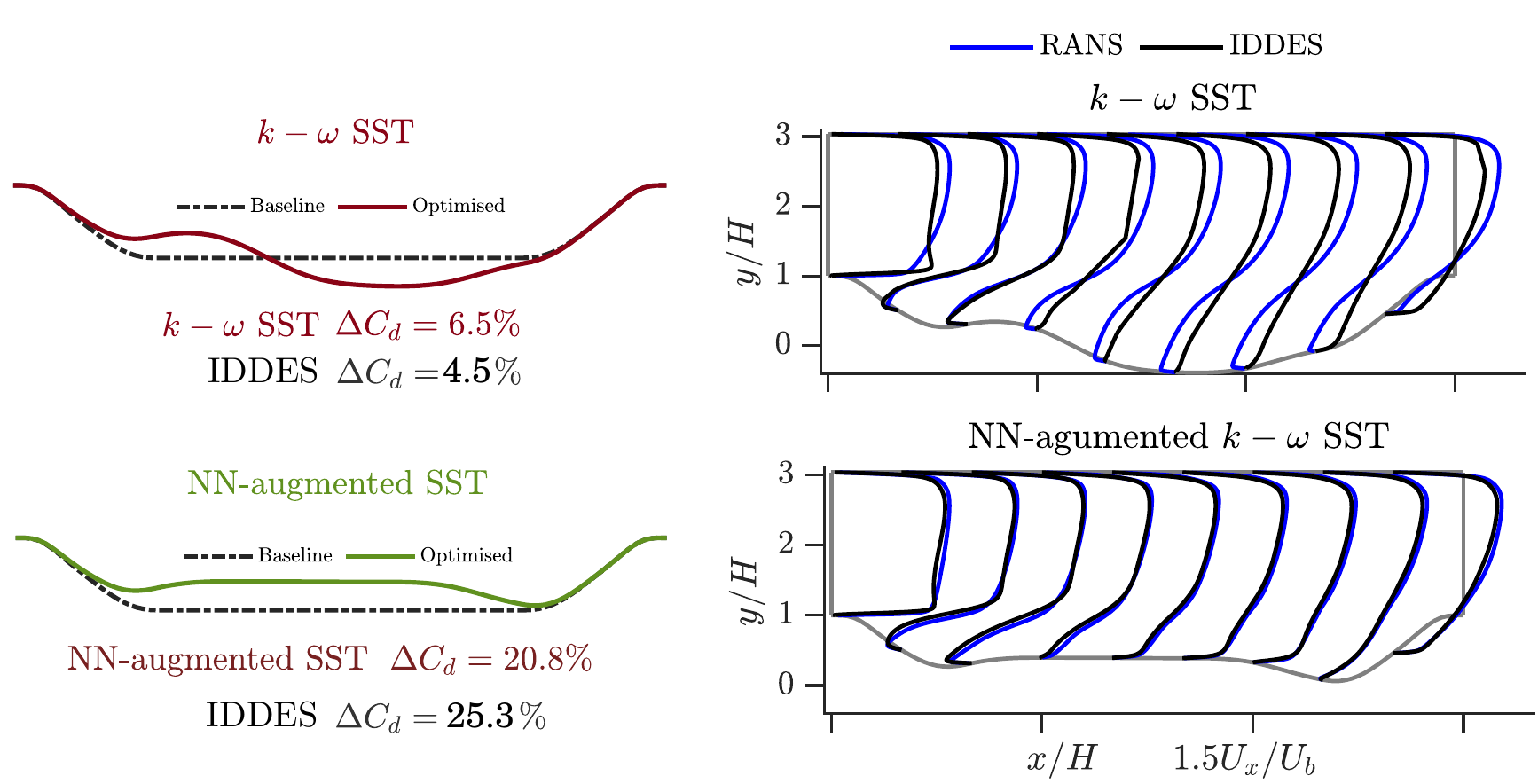
The key result is that the neural-network-augmented RANS model produced an optimised periodic-hill shape whose RANS prediction was much closer to the IDDES verification than the baseline \(k-\omega\) SST model. In the baseline case, RANS and IDDES did not agree strongly on the achieved drag reduction or on the resulting velocity profiles. With the augmented model, the RANS prediction and IDDES check were much more consistent.
That is the important engineering point: the optimiser can run using a RANS model, avoiding the computational overhead and adjoint difficulty of optimising directly with IDDES, while the final design is checked against a higher-fidelity method. The result should be read as evidence for this workflow on the tested separated-flow problem, not as a universal guarantee for all aerodynamic optimisation cases.
Relevant publications:
- Aerodynamic Shape Optimisation Using a Machine Learning-Augmented Turbulence Model — AIAA SciTech Forum, 2024.
- A Hybrid RANS-LES Dataset for Data-Driven Turbulent Mean Flow Reconstruction — CUFS, 2024.
- Data-driven Augmentation of Turbulence Models for Complex Fluid Flows — PhD thesis, University of Sheffield, 2024.
Related code: