Aerodynamic Shape Optimisation Using a Machine Learning-Augmented Turbulence Model

 The parameterised periodic hill geometries.
Abstract
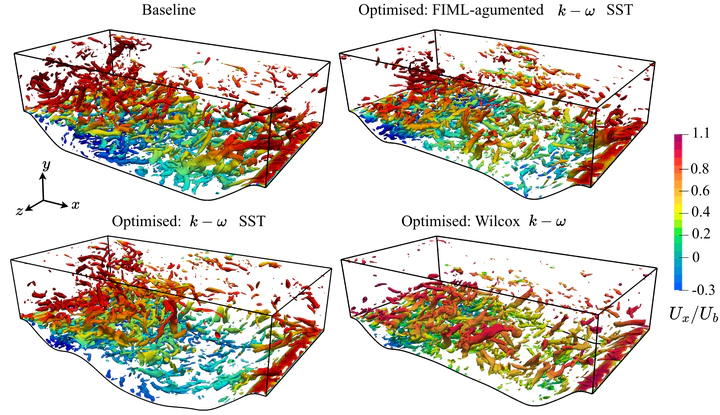
This paper presents an aerodynamic shape optimisation approach that utilises machine learning techniques to augment the turbulence model for the steady-state Reynolds-averaged Navier-Stokes (RANS) simulations—which are prone to inaccuracies for complex flows involving phenomena such as separation. We employ the field inversion and machine learning (FIML) approach which infers model discrepancies by solving a number of inverse problems (for different shapes and/or flow conditions) given some high-fidelity data, and uses machine learning to generalise the discrepancy fields for unseen cases. As a proof-of-concept we use direct numerical simulation (DNS) data for a set of parametrised periodic hills to augment the two-equations $k-\omega$ SST model using FIML, then incorporating it in the CFD solver for aerodynamic shape optimisation where the cost function is the drag minimisation. To illustrate the inherent optimisation sensitivity to the choice of turbulence model, we also use the Wilcox $k-\omega$ model for comparison. Once the optimal shapes are achieved for the different turbulence models, we propose using the hybrid RANS-LES improved delayed detached eddy simulations (IDDES) to validate the flow predictions, which in turn is validated against the available DNS data. Results highlight the sensitivity of optimisation to the turbulence model in the presence of flow separation, and the FIML-augmented model is able to achieve the maximum drag reduction, while the predictions are in good agreement with the IDDES results.
Type
Publication
American Institute of Aeronautics and Astronautics