Turbulent Mean Flow Reconstruction Based on Sparse Multi-sensor Data and Adjoint-based Field Inversion

Abstract
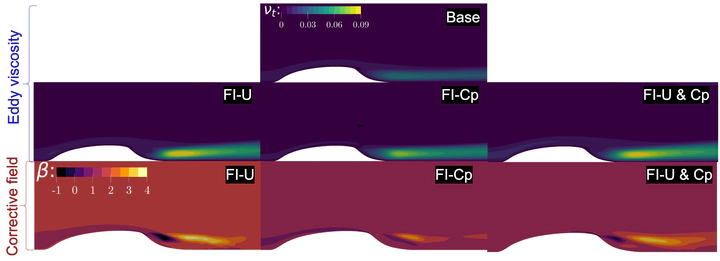
There is significant interest in using limited, experimentally measurable, data to reconstruct turbulent mean flows. One approach to achieve this is field inversion, which involves introducing a spatially varying field in the transport equation of the turbulence model, and optimising this field such that the error between the data and model predictions is minimised. This highly dimensional inverse problem is solved with gradient-based optimisation, driven by efficient derivative computations of the cost function using the adjoint method. It has been used to achieve promising results using limited observations from one data source, such as lift force, surface friction etc. In practice, experimental data are often disparate in nature–various quantities from different parts of the flow domain, with varying dimensions and quality. In this work, we will investigate the use of field inversion with disparate data based on sensor fusion for augmenting the Spalart-Allmaras turbulence model. The separated flow over the periodic hills is used as a test case, with initial datasets comprising of velocity profiles, and surface friction. Results highlight improved mean flow reconstruction when incorporating multiple quantities, compared to only the velocity profiles or surface friction. In the final paper field inversion results for a separated airfoil flow with surface and wake measurement data will be presented.
Type
Publication
American Institute of Aeronautics and Astronautics